The Line That Actually Separates Rockledge From Viera Isn't on Any City Map
September 10, 2026
September 10, 2026
Two homes near the Rockledge and Viera border can list at the same price and still cost their owners a different amount every month for the next three decades. The gap has nothing to do with square footage, lot size, or which city name shows up on the address. It comes down to a line item most buyers never ask about until the closing disclosure lands in their inbox: whether that specific parcel carries a Community Development District assessment, and if it does, which bond series is still being paid off.
If you have been cross shopping Rockledge against Viera on price alone, you have been comparing the wrong thing. The city limit is not where the real cost divide runs.
A Community Development District is a special purpose local government created under Chapter 190 of the Florida Statutes. Developers use it to finance roads, drainage, and amenities up front, then repay the bonds over time through an assessment that shows up on the property's annual tax bill as a non-ad valorem line, separate from county and school taxes and separate from any private homeowners association due. It is public bond debt tied to the land, not a membership fee tied to the owner.
That distinction matters because the two costs behave differently. An HOA due can be voted on, adjusted, or renegotiated by the association. A CDD or district assessment is fixed for the bond term, and in parts of Viera that term runs well past 2050.
Viera is not one financial structure wearing one name. Viera East, the older section east of I-95, sits inside an actual Community Development District that owns and operates the Viera East Golf Course, funded through the tax bill assessment plus a roughly $230 to $240 a year Central Viera Community Association master due. Viera West uses a different vehicle, the Viera Stewardship District, which functions the same way on paper but is booked separately. Its FY2026 adopted budget lists two active bond series behind the assessment: one series borrowed $22.9 million with $14.5 million in interest, retiring in 2053, and a second series borrowed $25.4 million with $25.5 million in interest, retiring in 2054. The Stewardship District line on a Viera West tax bill runs close to $1,135 a year on top of whatever village HOA a buyer signs up for separately, and some of those village dues, at communities like Del Webb, run $319 to $384 a month on their own.
Here is the part that breaks the simple Rockledge versus Viera story. Not every Viera parcel carries this. Some older sections of Viera East, and some adjacent pockets of Suntree, do not sit inside a district boundary at all. Which side of that line a specific lot falls on has nothing to do with the builder or even the phase name on the sign. It depends on how that parcel was platted decades ago, and the only way to know is to pull the actual tax bill for that address.
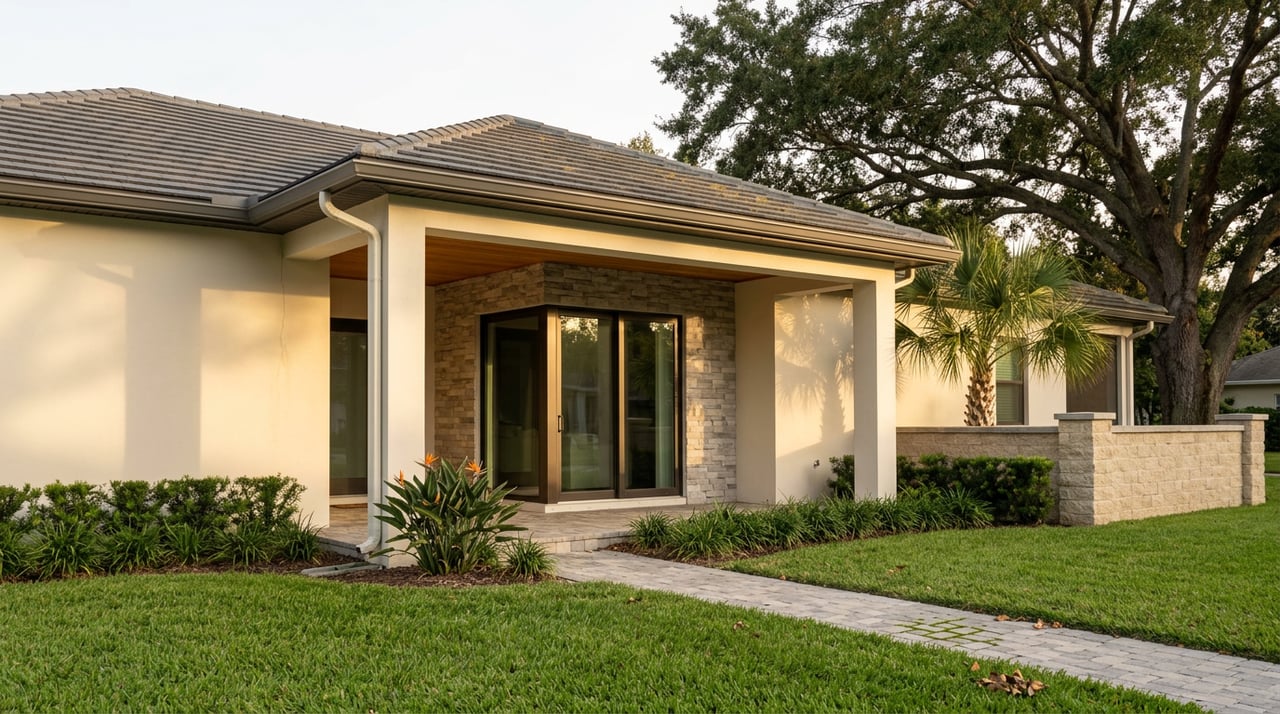
Rockledge's older, established neighborhoods carry none of this. Levitt Park's 1960s and 1970s ranch homes on big lots, priced in the high $300s to mid $400s as of mid 2026, have no HOA and no district assessment of any kind. Rockledge Acre Estates and Brackenwood are the same story: private ownership, no master association, no bond line on the tax bill.
What is more interesting is the newer Rockledge stock built right up against the Viera boundary. Capron Trace, a gated community off Murrell Road built mostly in the 2010s and 2020s with homes running high $500s to low $700s, has a pool, a clubhouse, and tree lined streets that read like Viera curb appeal, but it charges a private HOA due, not a Stewardship District line. Sonoma and Plantation Pointe, off Barnes Boulevard and built through the 2000s and 2010s, run high $400s to low $600s with sidewalks and a community pool and again, no CDD. Buyers in these communities get proximity to The Avenue Viera, the Brevard Zoo, and Duran Golf Club without the multi decade bond assessment that a Viera address two miles away might carry for a comparable amenity package.
That is the actual mechanism worth understanding before you tour either city: the amenity feel is transferable across the border. The financing structure behind it is not, and it does not track the border cleanly in either direction.
| Established Rockledge (Levitt Park, Rockledge Acre Estates) | Border zone Rockledge (Capron Trace, Sonoma) | Viera West (Stewardship District) | |
|---|---|---|---|
| Typical price range, 2026 | High $300s to mid $400s | High $400s to low $700s | Low $400s to $700s+ |
| HOA | None | Private HOA, community pool and clubhouse | Village HOA plus master CVCA due |
| District assessment on tax bill | None | None | Roughly $1,135/yr, bond term to 2054 |
| Who governs the assessment | Not applicable | Not applicable | Special district board under Ch. 190 |
The rightmost column is the one buyers underestimate. A $475,000 home in Viera West and a $475,000 home in border zone Rockledge are not the same monthly payment once that district line is added in. The gap has been reported elsewhere as running $100 to $300 a month depending on the specific assessment, and on a 30 year mortgage that difference compounds into real money before you ever touch the principal.
There is a related wrinkle specific to Rockledge right now, and it cuts the opposite direction. Rockledge funds its own downtown redevelopment, including the completed Barton Boulevard Civic Hub and related streetscaping, through its Community Redevelopment Agency, created in 2002 and amended in 2012. Per the agency's own audited financial report, that CRA is scheduled to sunset on September 30, 2026. Where Viera's infrastructure financing is a private bond mechanism that runs for decades, Rockledge's downtown improvements have run on a public tax increment structure with a fixed end date. Whether the city extends it past that date is not yet public information, but the contrast is worth sitting with: one city's growth engine is bond debt attached to individual parcels for 30 years, the other has been a public agency with a sunset clause. Neither approach is better or worse for a buyer, but they produce very different kinds of long term obligations, and only one of them shows up as a recurring charge on your personal tax bill.
Skip the neighborhood reputation and go straight to the parcel.
Does a lower list price in Rockledge always mean a lower monthly payment than a similarly priced home in Viera? Not automatically. A Rockledge home without a district assessment and a Viera home with one can land at very different real monthly costs even at the same purchase price.
Is a CDD assessment the same thing as an HOA fee? No. A CDD or Stewardship District assessment is public bond debt attached to the land and billed on the county tax statement. An HOA due is a private association fee that can be adjusted by vote.
Does buying in Rockledge guarantee no CDD? Established Rockledge neighborhoods currently carry none, but the only reliable confirmation is the tax bill for that exact address, not an assumption based on the city name.
How do I find out if a specific address carries one? Check the non-ad valorem assessments line on the most recent Brevard County tax bill for that parcel, and ask for the district disclosure summary before you go under contract.
If you are weighing a renovated Rockledge resale against new construction closer to Viera, the price on the sign is only the first number. Martin Castellon and the BrightBridge Holdings team can walk the actual tax bill and district disclosures with you before you write an offer, so the monthly payment you plan for is the one you actually get. Get Your Cash Offer Today.
Stay up to date on the latest real estate trends.
Get a no-obligation cash offer from Martin — no listings, no showings, no waiting.